

Environmental Sustainability

Going Green ?
Why Green?
Going Green is a Win – Win choice for business and the environment. It benefits business, employees, suppliers and most importantly their customers. In other words it’s good for the earth!
Going Green makes good business sense. When a company acts irresponsibly,it makes headlines. But when a company acts responsibly and ethically, it builds positive relationships and lasting trust. We believe that our company’s reputation is strongly linked to our commitment to Corporate Responsibility (CR), a commitment that begins in the workplace and extends to our operations, local communities and customers.
What is “Green” ?
Surprisingly, the most basic definition of “Going Green” is relatively simple. It’s basic theme is all about minimizing the potential negative environmental impacts of your business and using all of your resources as efficiently as possible. Continually seeking to eliminate all types of waste, protect the environment and increase operational efficiency to become more sustainable, while reducing total costs.
In order to maneuver through the complexity and confusion that creeps in when you start building in the details, every company needs a clear vision of “Going Green,” along with specific, measurable and achievable goals that maximize value. Start with the vision and the goals to provide focus and motivation during the program development process.
It’s obviously easier to have an impact on things that you can directly control, so we are starting with a vision and specific goals tailored to our business first and then start looking toward our supply and distribution distribution chain.
Why Sustainability
The Cone Inc. 2007 Environmental Survey shows what consumers expect of themselves and from businesses that they patronize. Consumers indicate that they are focusing on pro-environmental actions in three areas:
- Conserving Energy (93%)
- Conserving Water (86%)
- Recycling (89%)
As for business, consumers expect them to take the following steps to become more sustainable:
- Reducing pollution throughout office & manufacturing operations (71%)
- Designing products/packaging with more environmentally-friendly contents & minimal packaging (69%)
- Distributing & transporting goods more efficiently (69%)
- Communicate environmental efforts to employees and customers, so they can support those efforts (69%)
- Donating money to environmental causes (59%)
- Lobbying for more environmentally-friendly policies (57%)
Reduce, Reuse, and Recycle

A good starting point is to adopt and endorse the
Citizen’s 5 Step Action Plan
Inform and educate
Inform and educate yourself about the impacts of your energy choices
Change your habits
Change your habits in consuming energy in your household, at work and the rest of you daily life.
Challenge and support
Challenge and support local and state leaders to change the ways energy is produced and distributed in and for your community.
Elect and support
Elect and support national leaders who will take responsibility in developing and implementing a National Sustainable Energy Strategy.
Actively participate
Actively participate in a public national dialogue on our energy future.
Identifying Our Environmental Value Drivers

Every business and industry has it’s own unique issues to address in building a environmental sustainability program, but there are several common areas that all business can examine in building it’s approach.
Some of these common areas include:
Procurement
Are there alternative materials that we can use that are more environmentally friendly and provide no worse than a cost-neutral comparison to current materials? Can we use recycled materials in our business?
Energy Usage
How can we reduce the energy required to produce our products or services? Can alternative Green Energy sources be used to reduce Greenhouse Gas emissions in a cost-effective manner? Major energy centers include IT servers, heating and cooling, lighting, compressed air and process equipment.
Water and Sewer Usage
We are doing everything possible to minimize the use of water in our business, along with the resulting waste streams associated with water use? This includes items as small as landscaping around buildings.
Printing and Packaging
We are reorganizing our printed materials and packaging to eliminate all but the absolutely necessary elements and utilize recycled materials? We will try to use the internet and electronic data transmission wherever possible.
Waste Minimization
We have implemented programs to recover and recycle or reuse valuable commodities and reduce the solid waste streams flowing from your offices and facilities.
Janitorial and Maintenance Services
We use non-toxic materials/products and practicing preventative maintenance on key systems to maximize their efficiency.
Shipping
How can we minimize the need to ship materials? We use pdf electronic documents, web conferences and/or e-mail whevever possible. When we do ship materials we try to use the most efficient containers and carriers. Are you recovering and recycling your current shipping containers?
Employee Commuting
We offer telecommuting options for appropriate job classifications. AFIG offers programs and/or incentives for employees to use public transportation, carpools, bicycles or walking routes to get to and from work.
Carbon Footprint
Is it important that we quantify our existing carbon footprint and develop greenhouse gas emission reduction plans and goals.
Energy and Climate Change
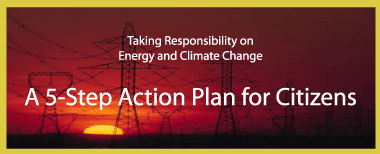
In the United States, as in other parts of the world, citizens are increasingly concerned about the threats to our future posed by climate change and our addiction to fossil fuels. In turn, many US citizens recognize the need to take responsibility for ourselves and our country in transforming the ways we produce and consume energy in our households, communities, regions and nation.
Get Involved in Going Green and be the Difference

Please call or email us for more information about our environmental sustainability program.
General Information Request Form

Contact us by phone (800) 874-9191, FAX (602) 992-8327 or email below for more product information.